
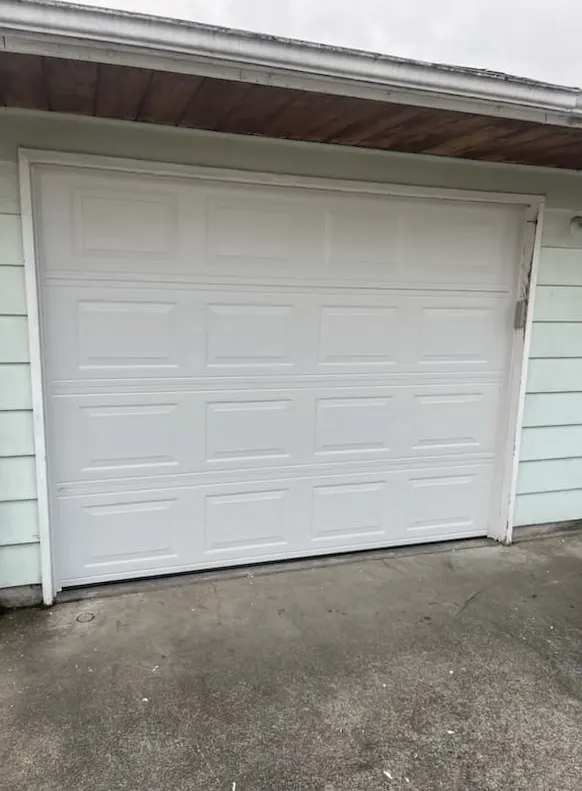
You hit the opener button on your way out and the door stops halfway, groans, and drops an inch with a bang. Or maybe you walked past the garage and noticed the door is hanging crooked, one side lower than the other. Either way, you're now holding your phone, calling around for quotes, and within an hour you have three numbers that don't look anything alike. One tech quoted $180. Another wants $650. A third won't give you a number until he's "seen it in person," which might be fair, or might not be.
Before you say yes to any of them, it helps to know what a real quote looks like, what you can safely ignore, and what to ask so you're not surprised later.
What a Real Quote Should Include
A written quote — even a short one texted to you — should spell out enough that you could hand it to a different company and they'd understand exactly what's being done. Look for:
- The specific part or parts being replaced — not just "spring repair" but which spring (torsion or extension), the size or wind-load rating if it's a torsion spring, and whether one or both springs are being swapped.
- Labor and parts broken out separately, or at least a note that the price is all-in. A $400 flat number for a spring job could be fair or inflated — you can't tell without knowing what's inside it.
- A service call or diagnostic fee, and whether it's waived if you proceed with the repair.
- Warranty terms on both the part and the labor, in writing, not just spoken.
- Any additional work the tech recommends while they're there — cables, rollers, hinges — listed as optional line items, not bundled in automatically.
If a quote has all of that, you can compare it apples-to-apples against another company's number. If it doesn't, ask for it before you agree to anything.
What You Can Safely Ignore
Not everything on a quote (or said during the visit) needs to worry you. A few things that are normal and not red flags:
- A range instead of an exact number before the tech has physically inspected the door. Springs, drums, and track all vary by door weight and size, so a phone quote is often a reasonable range, not a final figure.
- A recommendation to replace both springs even though only one broke, especially if the door is several years old. Springs are rated for a certain number of cycles and usually wear at close to the same rate — replacing just one often means a mismatched set and a repeat call sooner than you'd like.
- Mention of rust or corrosion on hardware near the coast or on older doors. South Florida's humidity and salt air eat through standard hardware faster than it would in a drier climate, so some surface rust on springs, hinges, or tracks isn't a sign of a shady tech padding the bill — it's often just the environment.
Questions to Ask Before You Say Yes
A good technician won't mind any of these. If they get cagey or rush you past them, that's worth noting.
- What exactly failed, and why? A rusted-through spring, a broken cable, a stripped gear in the opener — you should get a plain answer, not just "it's old."
- Is this the right part for my door's size and weight? Doors vary a lot, and using an undersized spring or the wrong gauge cable is a common shortcut that fails again within a year.
- Is the hardware rated for wind load? If you're replacing the door itself, or doing major track or spring work, ask whether the components meet wind-load requirements for this area. Hurricane season isn't year-round, but when storms do come through, you don't want to find out your door wasn't built for it.
- What's covered under warranty, and for how long? Get it in writing — parts and labor are often covered separately, and the labor warranty is usually shorter.
- Will this fix cause a problem somewhere else? For example, replacing a spring without checking worn rollers or a bent track just moves the next failure down the road a few months.
- Is there a cheaper, honest option? Sometimes a full opener replacement is pitched when a new logic board or sensor would do. It's fair to ask if there's a lower-cost fix that still solves the problem.
When the Numbers Still Don't Add Up
If a quote feels off, trust that instinct. A price that's dramatically lower than everyone else's often means a thinner spring, a reused part that should be replaced, or an add-on fee waiting at the end of the job. A price that's dramatically higher isn't automatically wrong either — it might include heavier-duty parts suited to a bigger door or a humid, coastal environment — but you're entitled to ask why before you agree.
A Quick Gut Check
Before you sign off, read the quote back to yourself and ask: do I know what part is being replaced, what it costs, what the labor costs, and what happens if it breaks again next month? If you can answer all four, you're in good shape.
When to Call Coral Springs Overhead Door Co
If your spring has already let go, your door is grinding off its track, or you just want a second opinion on a quote someone else gave you, that's exactly the kind of call we take every day. We'll walk you through our Garage Door Spring Repair pricing in plain terms — what part is failing, why, and what it'll cost to fix it right — before any work starts. And if the quote you're holding is more about an aging system in general than one broken part, our Garage Door Maintenance & Tune-Up service can catch worn cables, rollers, and hardware before they turn into a Saturday morning emergency.
If you're in Coral Springs, Parkland, Coconut Creek, Margate, Tamarac, Deerfield Beach, Boca Raton, or Pompano Beach and you want a straight answer on a garage door repair quote — yours or ours — give Coral Springs Overhead Door Co a call. We'll tell you what's actually wrong and what it should cost to fix it.